
Self-Compassion: An Invaluable Tool in Your Mental Health Journey
For many of us, having compassion and holding space for others comes naturally. We see someone we care about who is suffering emotionally—maybe heartbroken after a relationship ended, or beating themselves up after a work presentation didn’t go so well—and we are able to meet their emotion with kindness and care. Often we can extend this warmth and grace even while acknowledging that our loved one made a mistake or somehow contributed to their own pain—perhaps they were neglectful of their partner, which led to the breakup, or they didn’t prepare for that work presentation. We are still able to recognize the goodness and humanity in them, see that they are hurting, and be there with them through those feelings.
So if we can show compassion for others’ pain, why is it so freaking hard to show compassion toward ourselves?
There’s no one answer to this question, but I have some theories. For example, women and AFAB folks in particular are socialized to put the needs of others’ before our own—therefore it is easier to show compassion and care toward others than for ourselves. Capitalism constantly reiterates individual responsibility. We are each individually responsible for our lives, our successes and our struggles, and therefore when we experience pain and suffering we have nobody to blame but ourselves. And I even think about how in preschool and kindergarten, children are explicitly taught how to be kind to and help others—less so about how to be kind to and help ourselves.
Regardless of where it comes from, humans generally have an easier time showing compassion toward others than toward themselves. Self-compassion is more of a learned skill than an innate tendency for many folks. Learning this immensely powerful practice can be absolutely transformative, especially for folks who struggle with painful emotions like guilt, shame, and self-blame. It is not only something I incorporate into my work with therapy clients, but also an integral part of how I take care of my own mental health.
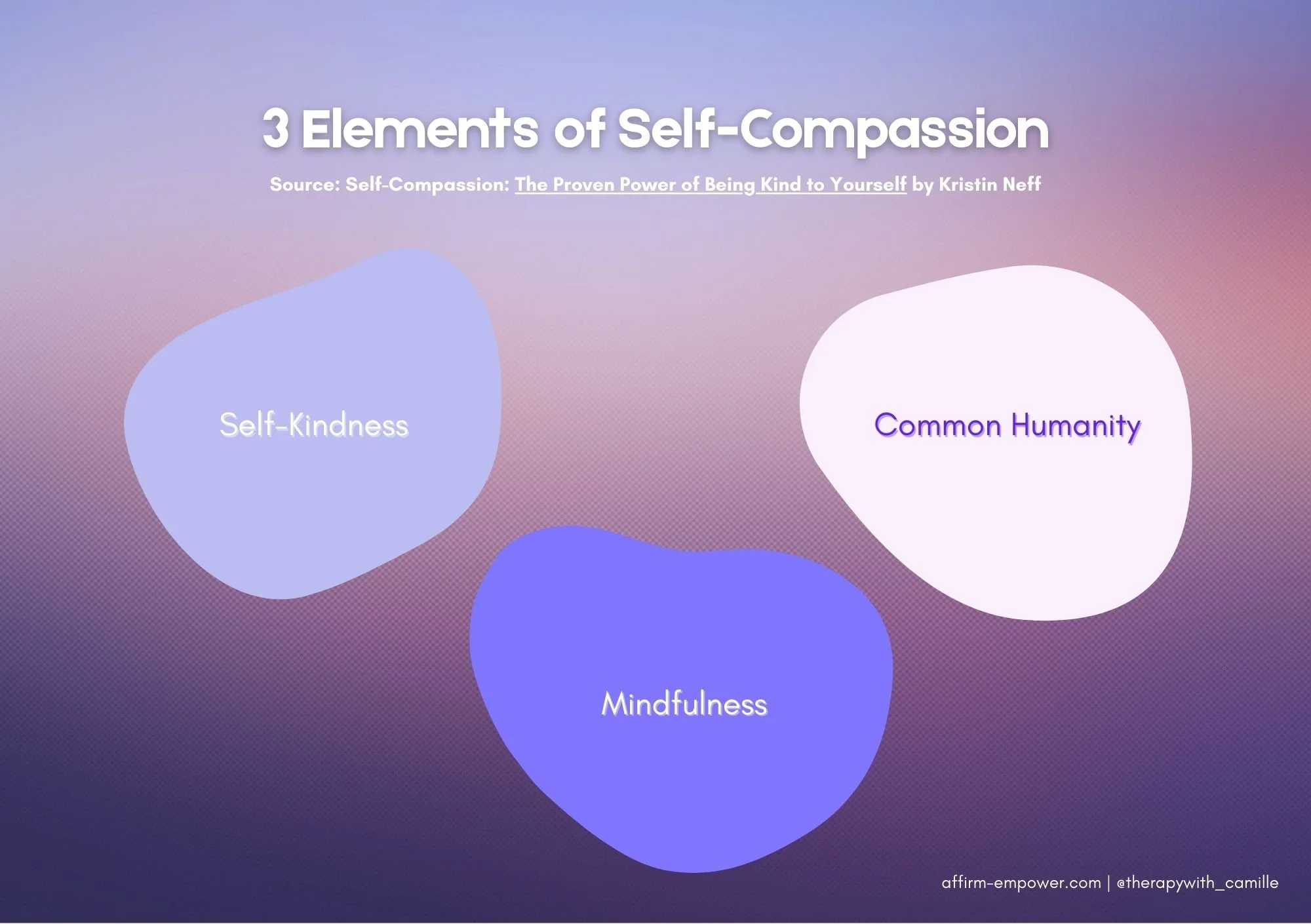
Self-compassion is comprised of 3 key elements:
Self-Kindness—the actual act of being kind and gentle with ourselves. Responding to our painful thoughts and emotions without shaming ourselves, but instead with validation, understanding, and care.
Common Humanity—the understanding that all humans make mistakes and experience suffering.
Mindfulness—the ability to notice our thoughts and feelings in a given moment and remain in the present, rather than become wrapped up in negative thinking.
When we practice self-compassion, we notice our thoughts and feelings without judgment. We remind ourselves that all humans are imperfect and experience suffering on some level; we are not alone in feeling this way. We meet our painful thoughts and feelings with kind words and comfort: “I know this is hard right now. It’s understandable I feel this way. I’m here with myself and I am deserving of comfort and care.”
One quick way to tap into self-compassion is to, when we are having a hard time for whatever reason, stop and reflect: how would I respond if this were my loved one, feeling and talking to themselves this way? Think about one of the people you care about most deeply—a close friend, your spouse, or child, etc. In many circumstances, you would notice right away that the way you are speaking to yourself and meeting your difficult feelings or thoughts— “This is all my fault”, “I don’t deserve xyz”, “I just need to get over it”—is drastically different than how you would treat our loved one. Once you have noticed the difference in how you are responding to your own pain versus how you would respond to others’, you can take a few deep breaths, remind yourself of your common humanity and your deservingness of compassion, and then begin to meet your feelings with more compassionate thoughts (see examples above).
Finally, it’s important to acknowledge once again that self-compassion is for most a learned skill, and that it is an active process. It is something that one consciously chooses to do, and will take practice. But when utilized, it can relieve so much unnecessary suffering. We are essentially allowing ourselves to feel, and be human, and make mistakes; we are learning to show up for ourselves and become a part of our own support system. And that’s pretty cool right?!
*Source: Neff, Kristin. (2011). Self-Compassion: The Proven Power of Being Kind to Yourself.